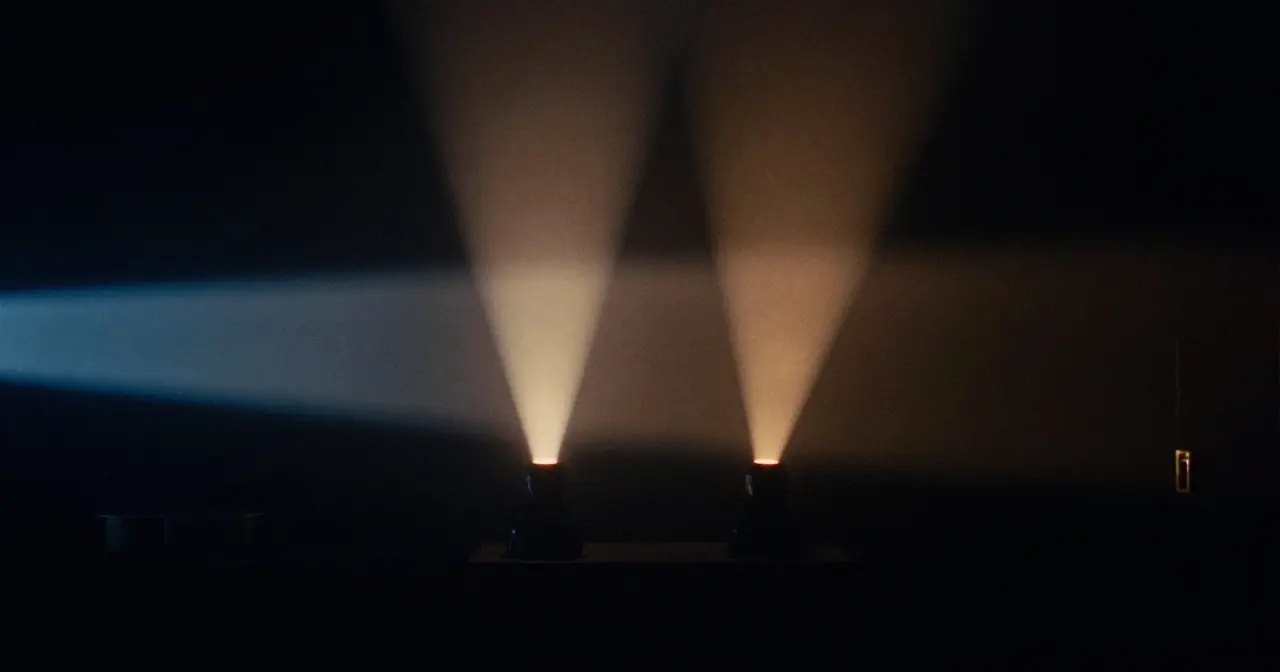
Richard Feynman said this experiment has in it the heart of quantum mechanics, and “the only mystery.” You can understand the setup in about a minute.
The setup
Take a wall with two narrow slits, and a screen behind it. Fire small things at the wall, one at a time.
If those things are marbles, you get two bands on the screen, one behind each slit. If you send water waves, you get a pattern of stripes, because the wave goes through both slits and the two parts interfere with each other.
Now fire electrons, one at a time. Each lands as a single dot, as a marble would. But as the dots pile up, they form stripes. Each electron appears to have gone through both slits and interfered with itself.
The part that bothers everybody
So you put a detector at the slits to see which one each electron really uses. Now the stripes vanish. You get two bands, as with marbles.
Remove the detector and the stripes come back. Physicists have run versions of this with electrons, atoms and molecules of nearly two thousand atoms, and it keeps working.
What it means
Here is the careful version. Before measurement, a quantum system is described by a wave of possibilities. When something in the environment records which path it took, the interference is lost. The particle does not need a person. A detector is enough, even a stray air molecule. Physicists call this decoherence.
Why do we then see one result and not all of them? That is the unsolved part. Copenhagen, many-worlds, pilot waves and others each give a different answer, and all fit the data.
Why people reach for rendering
If you have built a video game, this will feel familiar. Games do not compute what no one is looking at. The world behind you exists as a rule for producing it until you turn around. Programmers call this lazy evaluation.
So the temptation is obvious: reality behaves like a system that saves work. Proverbs 15:3 then reads strangely well, because if everything is resolved in relation to an observer, the old claim that the eyes of the Lord are in every place starts to sound like an answer to the question of why the world keeps existing when you are not looking at it. Bishop Berkeley made essentially that argument in 1710.
We like this as a question. We do not offer it as evidence, and you should be suspicious of anyone who does.
Reality really is stranger than the marble picture we were raised on. That much is settled physics. What it means for God, nobody has established. Be careful with anyone who tells you otherwise, in either direction.
Common questions
What is the double-slit experiment in simple terms?
Particles such as electrons are fired one at a time at a barrier with two openings. They build up a striped pattern on the far wall, as if each one passed through both slits like a wave. Add a detector that records which slit each one uses, and the stripes vanish.
Does the double-slit experiment prove consciousness affects reality?
No. What matters is whether which-path information gets recorded in the physical world. A detector does that whether or not anyone ever reads it. The idea that a conscious observer is required is a minority view.