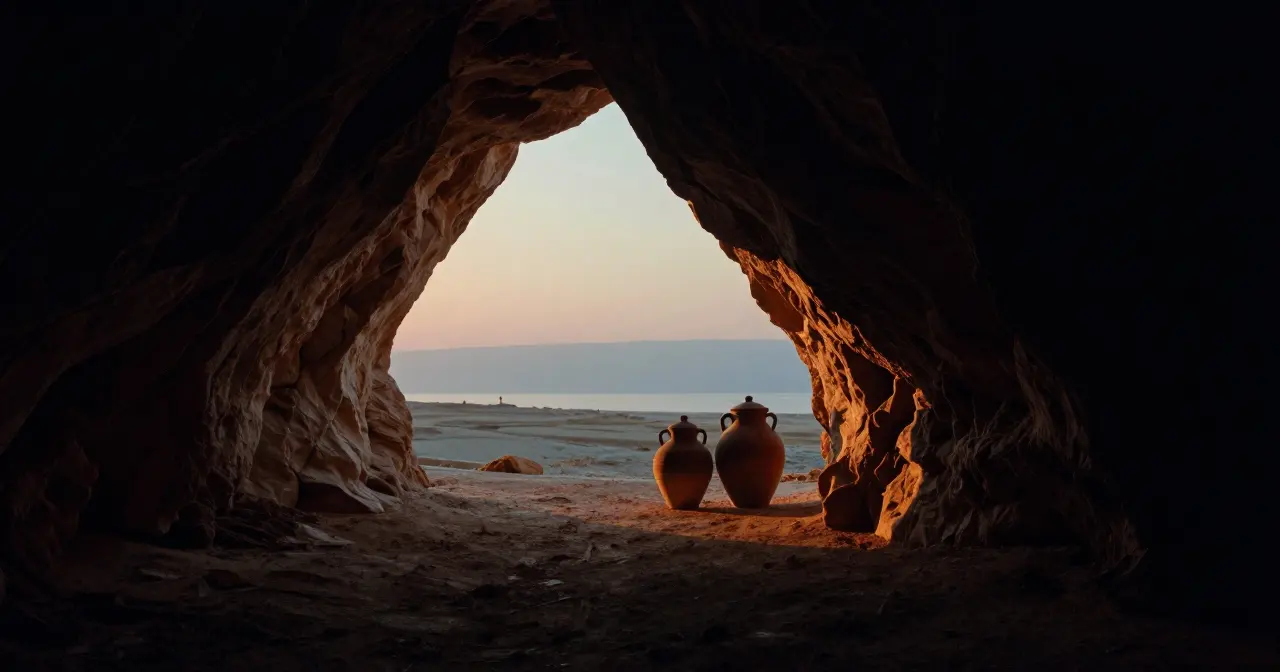
Before 1947, the oldest complete Hebrew Bible anyone could hold was about a thousand years old. Then, as the usual story goes, a young Bedouin shepherd near the Dead Sea threw a rock into a cave and heard pottery break.
Over the next nine years, eleven caves near Qumran produced about 900 manuscripts, many reduced to thousands of fragments. The oldest date to around 250 BC. The newest date to the Roman war that ended in 68 AD.
What they contain
The scrolls fall roughly into three groups.
The Bible. Every book of the Hebrew Bible except Esther appears at least in fragments. The Great Isaiah Scroll runs to all 66 chapters and is about a thousand years older than the previous oldest copy.
The books that did not last. Enoch in Aramaic. Around fifteen copies of Jubilees, more than most biblical books. The Book of Giants. Tobit and Sirach in their original languages. Whoever kept this library did not draw the line where later readers did.
The sect’s own writing. The Community Rule, the War Scroll, and commentaries that read the prophets as if they were describing current events. Someone here believed the end was close.
What they changed
They settled one argument and opened another. The Great Isaiah Scroll shows that copyists could carry a text across a thousand years with remarkably little change. But other scrolls show different editions of the same book in use side by side. Jeremiah appears in a shorter version and a longer one.
So the Bible as a single fixed text is something that happened later. In the century before Jesus, serious Jews were reading scripture in more than one edition, and treating Enoch as worth keeping alongside it.
What they do not say
They do not mention Jesus, and neither do they mention any early Christian. Decades of theories said otherwise, including one that decoded the Teacher of Righteousness as James or Paul. None has survived serious study.
Be careful with the market too. In 2020, independent investigators found that all sixteen of the Museum of the Bible’s “Dead Sea Scroll” fragments were modern forgeries.
Where to start
Spend ten minutes zooming into the Great Isaiah Scroll online, and you will feel it. For reading, Geza Vermes’s paperback is the standard. For the history, John Collins’s short biography of the scrolls is excellent.
We compare them in the best books on the Dead Sea Scrolls.
Common questions
What are the Dead Sea Scrolls?
About 900 Jewish manuscripts in Hebrew, Aramaic and some Greek, found in eleven caves near Qumran between 1947 and 1956. They include the oldest known copies of books of the Hebrew Bible, along with other religious writings and the rules of a sect.
Do the Dead Sea Scrolls mention Jesus?
No. Most of them were written before his time, and none of them name him, John the Baptist or any early Christian. Claims to the contrary have not held up.
Do the scrolls prove the Bible has not changed?
Partly. The Great Isaiah Scroll is strikingly close to the medieval Hebrew text, a thousand years later. But other scrolls show that several versions of biblical books existed side by side, so the picture is one of careful copying and of real variety.
Can I see the Dead Sea Scrolls online?
Yes. The Israel Antiquities Authority's Leon Levy Digital Library has thousands of high-resolution images, and the Israel Museum hosts the Great Isaiah Scroll.