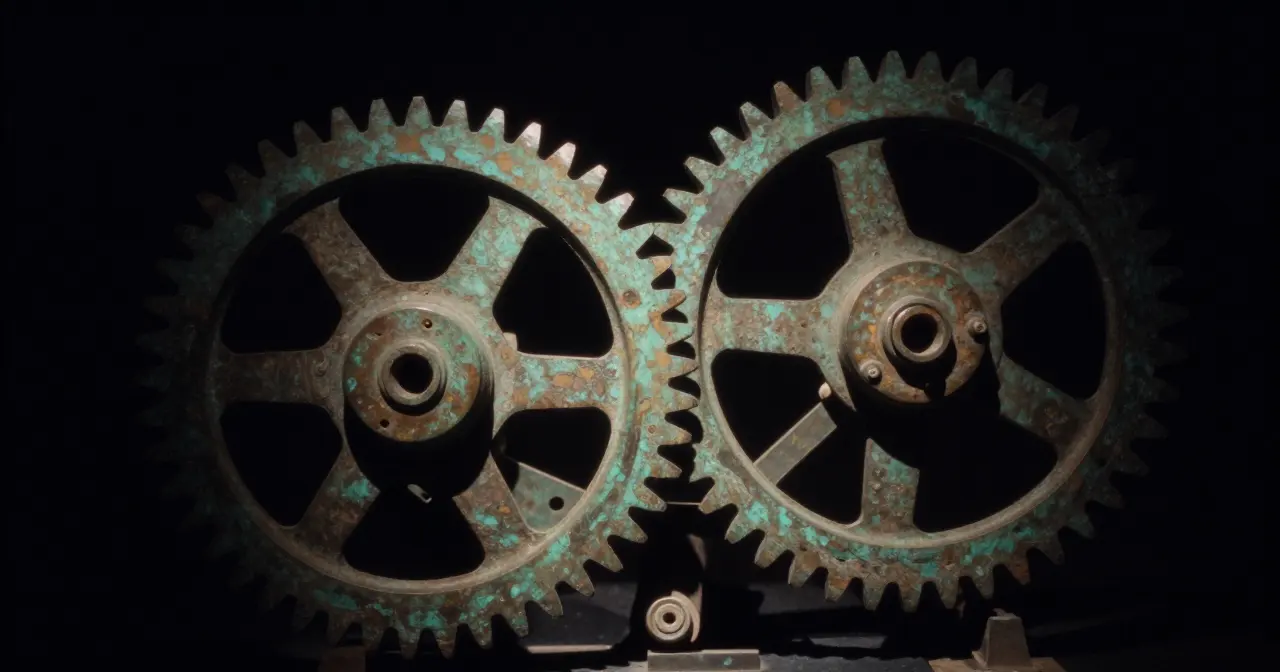
In 1900, sponge divers sheltering from a storm off the Greek island of Antikythera found a Roman-era shipwreck loaded with statues. Among what they brought up was a lump of corroded bronze. Months later, it cracked open in the museum in Athens. There was a gear wheel inside.
No one believed it for decades. Nothing like that was supposed to exist in the ancient world.
What it was
X-rays in the 1970s and CT scans in 2005 eventually showed what it was. The device was about the size of a shoebox and held at least 30 interlocking bronze gears with hand-cut triangular teeth. You turned a handle, and dials moved.
It tracked the sun through the zodiac. It tracked the moon, using a clever pin-and-slot system to model the moon’s changing speed. It predicted eclipses on an 18-year cycle called the saros. A small dial even showed which athletic games were due, including the Olympics. Its surfaces have thousands of tiny engraved characters, in effect the user manual.
It may have shown the planets as well, and a 2021 study from University College London proposed a full reconstruction.
Why it is unsettling
Nothing of comparable complexity shows up in the record for more than a thousand years. Medieval cathedral clocks are the next time we see this kind of gearing.
The sensible explanation is not aliens or Atlantis. Bronze was valuable, so old devices got melted down. Cicero mentions Archimedes building a sphere that showed the motions of the sun, moon and planets. The mechanism is unlikely to have been the first of its kind, since the craftsmanship shows practice. We found this one because it sank. There were probably others, and all of them were recycled.
So the point is not that the ancients had secret technology. It is how little of what they knew has survived. A whole tradition of precision engineering may have vanished, and we know about it because of one shipwreck and a storm.
That should sound familiar if you have been reading our library. Survival is an accident, and the record is what happened to be left.
Why it belongs on this site
It models the heavens with mathematics in a machine. Someone in the second century BC believed the sky ran on rules, believed those rules could be captured in gears, and then built it.
Set that next to Psalm 19: “The heavens declare the glory of God.” The same sky, read in two languages. One writer looked up and sang, and the other cut teeth into bronze. We don’t think those two were doing entirely different things.
Jo Marchant’s Decoding the Heavens tells the story of the century-long effort to work it out, and it reads like a detective novel.
Common questions
What did the Antikythera mechanism do?
It modeled the sky. Turning a handle moved dials that showed the positions of the sun and moon, the phase of the moon, the dates of eclipses, and the calendar of athletic games. It likely showed the planets too.
How old is the Antikythera mechanism?
The shipwreck dates to around 70 to 60 BC. Estimates for when the device was built range from the late second to the early first century BC.