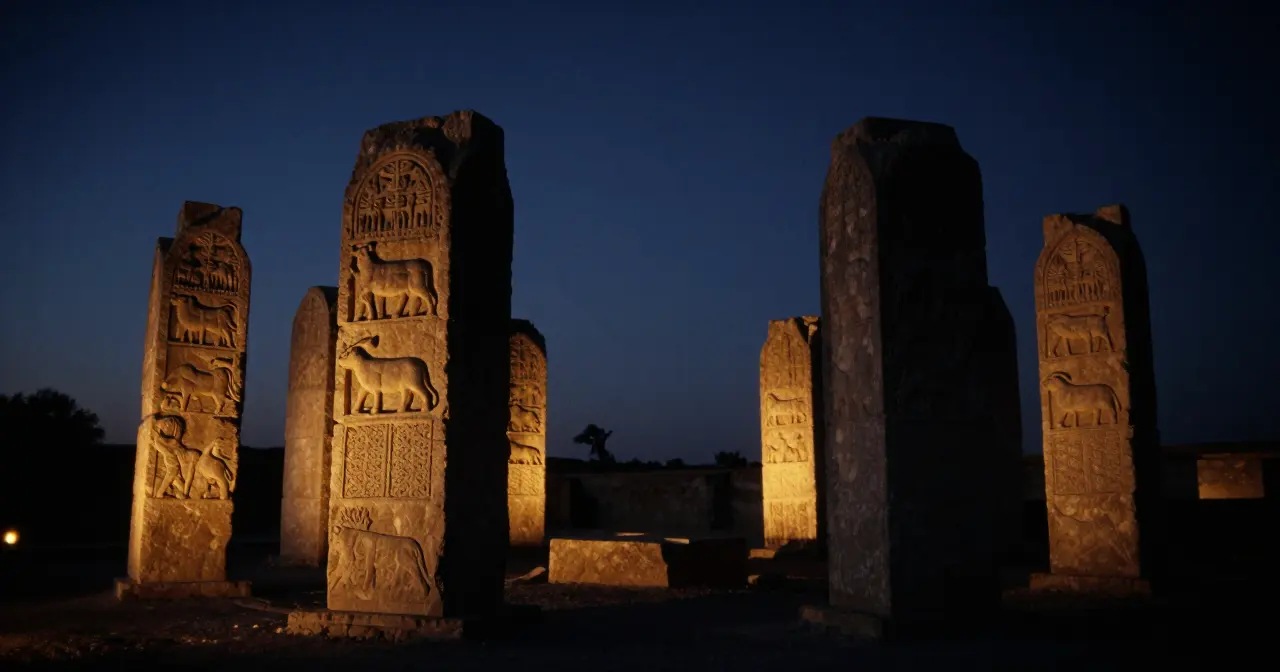
We were taught that first came farming, then towns, then surplus, then priests and temples. Göbekli Tepe, on a hilltop in southeastern Turkey, is the reason that picture has a big question mark on it now.
What is there
Rings of T-shaped limestone pillars, some over five meters tall and weighing many tons, carved with foxes, snakes, scorpions and vultures. Some have arms and hands carved along their sides, and are likely stylized human figures without faces.
They date to about 9500 BC. To put it in perspective, the pyramids are closer in time to us than to this site. Nobody had pottery in that region yet, nobody had the wheel, and the tools were stone. It is thought that the first domesticated wheat in the region was only starting to appear.
What it changed
Klaus Schmidt, the German archaeologist who began digging in 1995, put it memorably: first came the temple, then the city. Pulling off a project like this would need hundreds of people working in one place, and they would need to be fed. Maybe that is why people began to settle and to cultivate. They may have invented farming in order to keep gathering together.
If that holds up, it reverses a long-standing assumption. Religion would not be a luxury civilization develops once it has spare time. It would be one of the things that got civilization started.
Genetic work has tied the origins of einkorn wheat to Karaca Dağ, a mountain in the same corner of Turkey. That is suggestive, and it proves nothing alone.
What is being argued
The picture has gotten more complicated, which is usually a sign of good science.
Schmidt argued no one lived there. Later excavation has found houses, water systems and evidence of daily life, so “temple” may be too narrow a word.
The famous claim that the builders deliberately buried everything around 8000 BC is also under challenge. Recent studies of the site’s layers point to repeated slope slides, followed by repairs. The fill may be partly natural, and the question is still open. Older videos and articles, including an early draft of ours, repeat the burial story as fact.
Be careful with what comes next in your feed, too. The site gets used as evidence for a lost super-civilization, and nothing found there supports that. The story needs no aliens. What it asks you to accept is more interesting: people with stone tools did this.
The question it raises
We do not know what they believed, and they left no writing. But we know the oldest large thing we have found that humans built together was not a wall, a granary or a palace. Whatever else it was, it was a place to gather, covered with images, and arranged in circles around two central figures.
Question over conclusion. But sit with that one.
Common questions
How old is Göbekli Tepe?
The monumental enclosures date to about 9500 to 8000 BC, around 11,500 years ago. That is more than twice as old as the Great Pyramid.
Who built Göbekli Tepe?
People in southeastern Turkey who hunted and gathered at the very start of the shift to farming, as far as the evidence shows. Their tools were stone, and no metal has been found.
Was Göbekli Tepe deliberately buried?
For decades that was the standard account. More recent work points to slope slides and repeated repairs filling the enclosures, at least in part. The debate is still open.