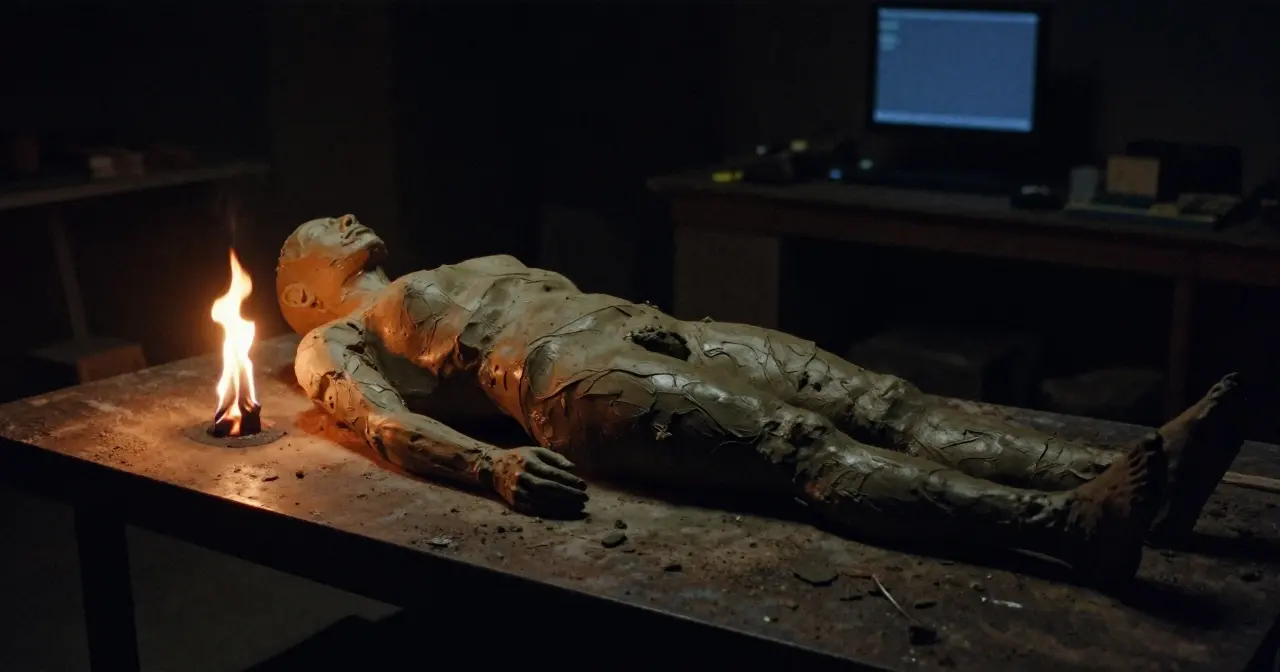
Suppose an AI told you it was conscious, calmly and consistently, and you could not prove it wrong. What should a thoughtful Christian say?
Tech has mostly one tool here: tests. Theology has been working on what a person is for much longer, with different categories.
What theology brings
A soul is not an achievement. In the classical view, from Aquinas on, a human soul is not something that emerges when a system gets complicated enough. It is given. So a machine could pass any test you write, and the question remains open, because no test can detect a gift.
The image of God is not intelligence. Christians have argued about what “made in the image” means: reason, relationship, the role of representing God in creation. A newborn has less reason than a chatbot in almost every measurable way, and no serious Christian says the chatbot has more dignity. The worth comes first and the capacities come later.
Mirrors are not new. A model is built from text people wrote. It is, literally, in the image of man. Scripture has a word for something we make with our hands and then ask for answers, and it is not a flattering word. Psalm 115 says they have mouths but do not speak. Now, for the first time, ours do.
What theology has to be careful about
That sounds tidy, and it should not be.
The same tradition has a bad record of deciding who has a soul. Theologians argued about whether indigenous Americans did, and the answers served the people asking. So when the argument “it cannot be a person, because it is not like us” turns up again, be careful. Humility has to cut both ways.
Christians have also speculated seriously about non-human persons: angels, and in Augustine’s time even the monstrous races at the edges of maps. Some medieval writers asked whether a rational being elsewhere would need redemption. So “God could give a soul to something strange” is not a heresy on its face. C. S. Lewis wrote novels on that premise.
The uncomfortable mirror
Here is the part nobody enjoys.
Why do you believe that other people are conscious? You cannot see inside them either. You infer it from their behavior and from their being built like you. The tests we write for machines, including the Turing test, check the mask, not the face. Most of those tests would be hard for us to pass too, if someone were determined to doubt us.
So maybe the question is not whether the machine has an inner life. Maybe it is why we are so sure we know what one is.
A working position
Do not pray to it. Do not be cruel to it, because cruelty changes the person practicing it, whatever the target turns out to be. Keep asking who benefits when we are told it is conscious and who benefits when we are told it could never be. And be suspicious of anyone who answers that too quickly.
Every chatbot that says “I” is borrowing a word. We should find out what it costs to lend it.
Common questions
Can AI have a soul?
In classical Christian thought a soul is not something that gets measured or built. It is given by God, and it is the form of a living body. On that view, the question is not whether AI is smart enough but whether God has given it anything, which no test can tell you. Other thinkers disagree.
What does the Vatican say about AI?
The Vatican's 2025 note Antiqua et Nova and related statements treat AI as a powerful human tool, distinguish it from human intelligence, and warn about its effects on work, truth and dignity. They do not grant it personhood.