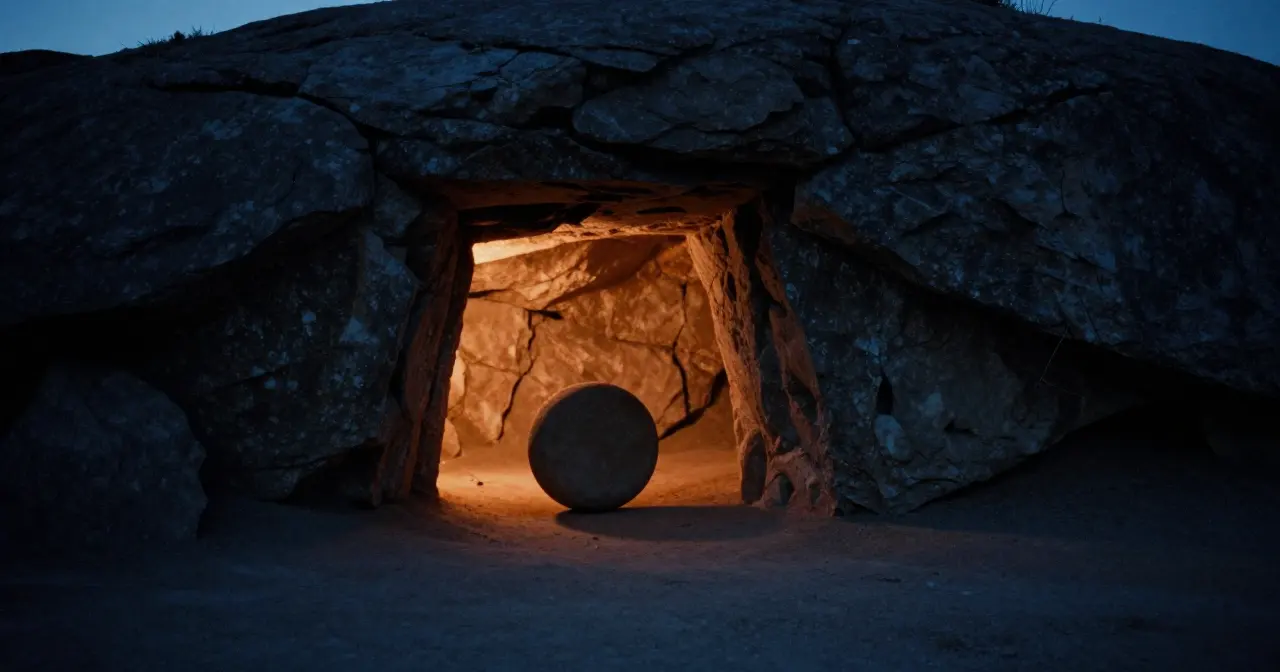
Silicon Valley and Christianity are making the same promise. The difference is the engineer.
Version one: the upload
Scan the brain finely enough to capture its pattern. Run the pattern on something that does not rot. Death becomes a hardware problem, and hardware problems get patched.
Serious people have backed this. Hans Moravec sketched it in the 1980s, Ray Kurzweil built a career on it, and companies have taken deposits for brain preservation. Meghan O’Gieblyn, who left Bible school and later fell into transhumanist writing, noticed something odd there: she knew this story. The rapture, the glorified body and the world remade were all present, with the serial numbers filed off.
Version two: the resurrection
Most people’s picture of the Christian hope is that when you die your soul floats away to heaven. That is closer to Plato than to Paul.
The claim in the New Testament is stranger. It is bodies. Jesus eats fish after he rises, in Luke 24. Thomas is told to touch the wounds. Paul, in 1 Corinthians 15, insists on it: sown in corruption, raised in incorruption. The creed says “the resurrection of the body,” and it means something specific. You get you back, embodied, physical, altered in ways nobody claims to understand.
What they share
Set side by side, the two have a lot in common.
Both refuse to accept death. Both say the current body is not the final version. Both imply that a person is something that can survive the destruction of their current substrate. In one story the pattern is kept on a server, and in the other it is held in the mind of God. John Polkinghorne, a physicist who became a priest, openly used this language: God remembers the pattern, and re-embodies it.
Where they split
Who does the porting. The upload says we will do it. Resurrection says we are not qualified.
What counts as you. A copy of your pattern is, at best, a copy. If I scan you and you are still alive, there are two of you, and only one is you. Uploaders mostly change the subject when this comes up. Believers have their own version of the question, and at least they are honest that it is a miracle.
What the body is for. For the transhumanist the body is a container, and a bad one. In Christianity it is the thing being saved. A Christian who hates the body has gotten the religion wrong.
What gets carried over. An upload brings your grudges and your vanity, forever, unless you edit them out. Then who edits? Resurrection, in Paul’s telling, comes with judgment and with being changed.
The question to ask
Which of these is true is beyond this site. But each of them forces a good question: what do you think you are? Are you the data, or was the data never all of you?
The upload says become information. The resurrection says that information was never the whole story. Decide which one you’d trust with your mother.