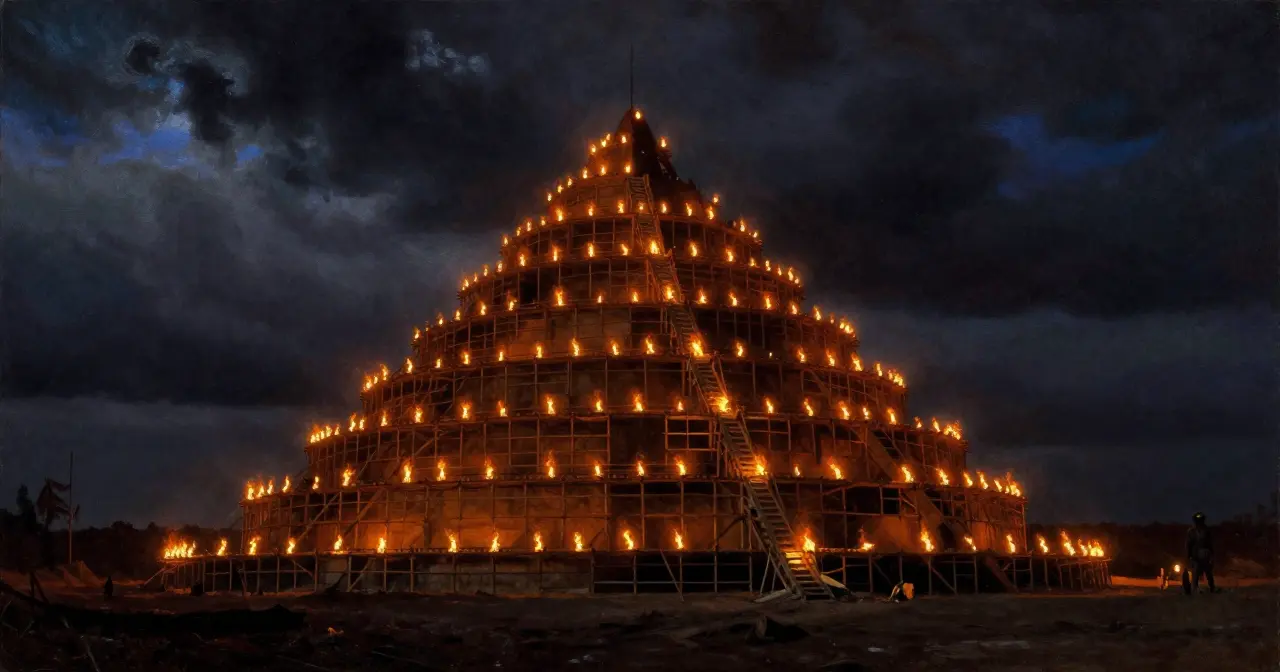
The story takes up nine verses. It may be the most compact description of a technology risk ever written.
The setup
All the earth has one language. People find a plain in Shinar, and they invent something: “let us make brick, and burn them throughly.” Mass-produced building material is new technology in this story, and the text pauses to tell you so.
They state their goal: a city and a tower with its top in heaven, “and let us make us a name, lest we be scattered.”
Look at that goal. It is not for anything. Nobody needs this tower. The objective is the project itself, plus status, plus a fear of losing coordination.
The line
God comes down to see it, and the next sentence is the one that should stop you.
Behold, the people is one, and they have all one language; and this they begin to do: and now nothing will be restrained from them, which they have imagined to do.
This is not an accusation. Nothing here says the people are evil. It is an assessment of capability: shared language, total coordination, and a growth curve with no visible ceiling. Capability has run ahead of any wisdom about what it is for. That is close to what researchers mean by alignment.
The intervention
Here is the part people miss. There is no fire from heaven and no flood. God has just promised not to do that again.
The response is to confuse their language. Nobody dies. The ability to coordinate is degraded and the project stalls. “They left off to build the city.”
In a systems vocabulary, that is a throttle. Break the coordination, slow the buildout and leave everyone alive to try something else. It is a surprisingly gentle thing for a story like this to choose, and it is a thing people propose today in much drier language: compute limits, pauses, a requirement for keeping some capabilities apart.
What we should not claim
The people who wrote this were looking at Babylon, with its enormous stepped temples and its empire, and they were not impressed. It is also a story about why people speak different languages. Neither of those has anything to do with GPUs.
We also do not get to say this settles the policy question. Plenty of thoughtful people think slowing AI would cost lives, and that the analogy flatters those who want to stop. The story also has an obvious reversal: Pentecost, in Acts 2, gives a picture of language barriers overcome as a gift. Coordination is not the sin.
The question it leaves
Babel does not ask whether you can build it. It says that you can, and that nothing will stop you. It asks what your name is for. Every system prompt and mission statement is answering that same question, and “lest we be scattered” still looks like a real reason why people keep building.
Common questions
What does the Tower of Babel story mean?
On the surface it explains why people speak different languages. Scholars also read it as a critique of imperial Babylon and its ziggurats. Readers have long taken it as a warning about human pride and unchecked power.
What is the AI alignment problem?
The challenge of making sure powerful AI systems pursue what people actually want, not a literal or distorted version of it, especially as they grow more capable than the people supervising them.