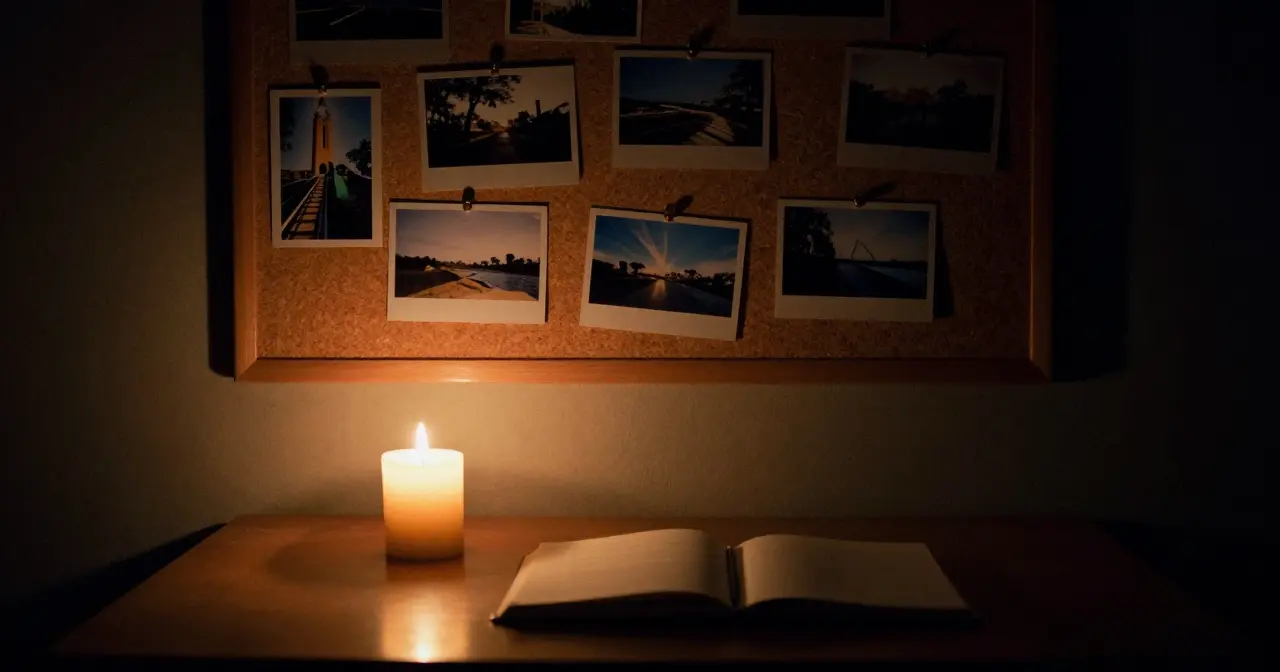
A vision board and a 500-year-old Jesuit prayer practice are the same technology pointed in opposite directions.
The vision board
You collect images of the life you want and look at them daily. Whatever you think of the metaphysics, the mechanics make sense. It tells your attention what to filter for, keeps a goal in view and steers small decisions.
The research suggests a catch. Gabriele Oettingen’s work shows that simply fantasizing about the outcome can drain the energy you need to get there, because your brain enjoys the arrival early. What helps is what she calls mental contrasting: picture the outcome, and then picture the obstacle in the way. Most vision boards do not show the obstacle.
The examen
In 1548 Ignatius of Loyola published the Spiritual Exercises, and he told his Jesuits that if they had to drop every other prayer because of work, they should keep this one. It takes about ten minutes at the end of a day:
- Stop, and remember that you are in God’s presence.
- Name something specific from today that you are grateful for.
- Walk through the day, hour by hour, like watching a film. Where were you most alive? Where did you shut down?
- Pick the one moment you most regret, and face it.
- Look at tomorrow, and ask for what you will need.
There is no affirmation. You don’t tell yourself anything. You look, and you find out what your day actually contained.
What each one misses
A vision board asks, “What do I want?” An examen asks, “What am I being shown?”
Run only the first and you may become a very focused stranger to yourself. You get good at steering and never check what is doing the steering. Plenty of people hit every goal on the board and then find out they had pinned up someone else’s life.
Run only the second and you might never aim at anything. You could spend years in careful review of a life you have not decided to live.
The saints seem to have run both. Ignatius himself was ambitious to the point of absurdity, a wounded soldier who decided to outdo Saint Francis. Then the Exercises taught him to sort his desires, and to ask which came from God and which from vanity. Desire, examined. Ambition, discerned.
Try both for a week
Keep your board if you have one, and add the obstacle to it. Then do the examen every night for seven nights, on paper. By the end of the week you will have a list of the moments you felt most alive, and you may find that very little of it is on the board.
Common questions
What is the Ignatian examen?
A short daily prayer developed by Ignatius of Loyola in the 1500s. You review your day in God's presence, notice where you felt most alive and where you closed off, and ask for help with tomorrow. It usually takes ten to fifteen minutes.
How do you do the examen?
Five steps: become aware of God's presence, give thanks for something specific, review the day hour by hour, face one failing honestly, and look toward tomorrow.